
3 Mind-Blowing Secrets of the Ancient Olympic Games (You Won't Find on the Info Signs)
Every four years, the whole world tunes in to watch the Olympic Games. When you walk through the ruins of Ancient Olympia, you are standing on the exact soil where it all began in 776 BC.
While the stone plaques on-site give you dates and architectural terms, the real magic of Olympia lies in the human drama, scandals, and engineering marvels behind the Games. Here are three of our favorite stories from the Olympia Back in Time audio guide that always leave visitors speechless.
1. The Giant Jigsaw Puzzle: How the Statue of Zeus Was Actually Built
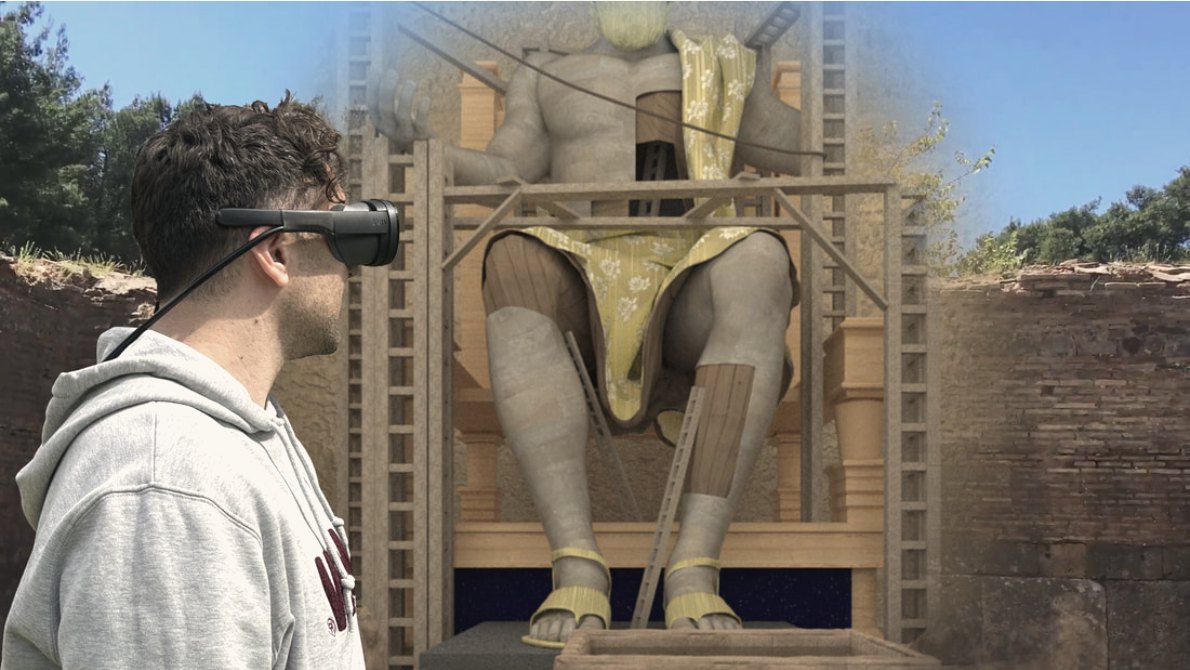
Standing over 12 meters (40 feet) tall, the gold-and-ivory Statue of Zeus was one of the Seven Wonders of the Ancient World—so huge that if Zeus had stood up, his head would have smashed through the temple roof.
But here is what surprises most visitors: the master sculptor Phidias didn't build the statue inside the Temple of Zeus. Instead, he built a separate workshop just outside the sacred precinct with the exact same dimensions and lighting as the temple's interior. Once the massive statue was completed inside his workshop, artisans carefully took it apart piece by piece, carried the gold and ivory sections across the sanctuary, and reassembled the entire colossus inside the Temple of Zeus! Today, standing in front of Phidias's still-standing workshop and seeing the sheer scale of the Statue of Zeus in 3D through our VR glasses is the #1 "wow" moment for visitors.
2. The "Walk of Shame": How Cheaters Paid for Their Own Humiliation
We like to imagine ancient athletes as noble heroes competing purely for an olive wreath, but human nature hasn't changed much in 2,500 years. Bribery and rule-breaking happened—and when an athlete got caught, it was the ultimate disgrace.
Instead of just banning the cheater, Olympic judges hit them where it hurt most: their wallet and their pride. Caught cheaters were forced to pay out of their own pockets to build bronze statues of Zeus, known as Zanes. These statues were placed along the stone wall right outside the vaulted tunnel leading into the stadium. Carved into the stone pedestals were the cheater's name, their father's name, and their city-state—warning every athlete walking onto the track that victory could only be won with fast feet, never with money.
3. The Loophole That Made a Spartan Princess the First Female Olympic Winner
In Ancient Olympia, the rules regarding women were harsh: married women were strictly banned from competing in—or even watching—the Olympic Games.
Yet in 396 BC, a royal woman from Sparta named Cynisca found a brilliant legal loophole. In the high-stakes four-horse chariot race (tethrippon), the Olympic crown wasn't awarded to the charioteer holding the reins—it was awarded to the owner and breeder of the horses, who didn't even have to be inside the stadium! Cynisca bred and trained a team of unbeatable horses, entered them in the Games, and won twice (in 396 BC and 392 BC), immortalizing her name as the first woman in history to win an Olympic victory.